How it happens
- Cutting the nail down at the corners. The commonest cause by a wide margin. Curving the cut into the corner leaves a small spike of nail below the skin surface, which then grows forward directly into the flesh.
- Cutting nails too short, so the nail no longer protects the tip of the toe and the soft tissue rides up over the free edge.
- Footwear that is too short or too narrow, pressing the nail fold against the nail edge with every step.
- Trauma — a stubbed toe, a dropped object, or the repeated microtrauma of running and stop-start sports.
- Nail shape. Some people inherit a strongly curved or involuted nail that is prone to this regardless of technique.
- Sweating and maceration, which soften the surrounding skin so the nail penetrates it more easily.
How it presents, and when it has become infected
It starts as tenderness along one side of the nail, worse with pressure from a shoe or bedclothes. As it progresses the fold becomes red, swollen and painful to touch. If infection develops there will be discharge, increasing pain and heat, and eventually the formation of exuberant granulation tissue — a fleshy, easily bleeding overgrowth at the nail edge that indicates a chronic, established problem rather than a new one.
Spreading redness up the toe or foot, fever, or feeling unwell means the infection is no longer local and needs same-day medical assessment. So does any ingrown toenail at all in someone with diabetes or reduced circulation, regardless of how mild it looks. The NHS ingrown toenail page and the OrthoInfo summary cover the same ground.
Cutting toenails properly
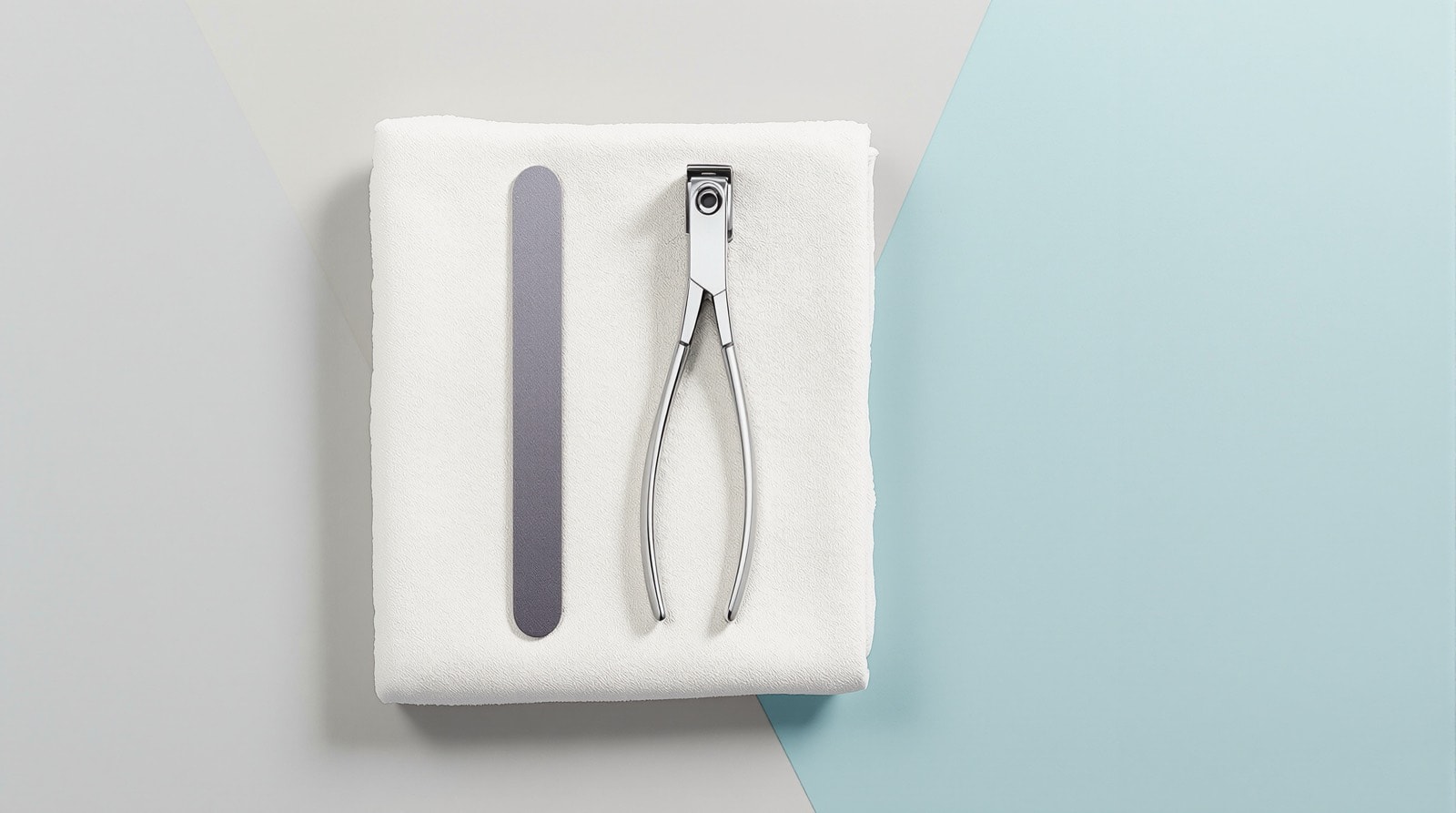
Straight across, following the general shape of the end of the toe, leaving the corners visible and slightly proud rather than cut down into the fold. Do not cut shorter than the end of the toe. Use proper toenail clippers rather than scissors or fingernail clippers, which are too small and encourage a curved cut. Cut after bathing, when the nail is softer. File any sharp edge smooth rather than picking or tearing it.
Do not attempt "bathroom surgery" — digging down the side of the nail with clippers, scissors or a probe. It is the most reliable way to turn a sore nail into an infected one, and the piece left behind is usually the piece that was causing the trouble.
Early self-management
For a mild, uninfected ingrown nail in an otherwise healthy foot: warm salt-water soaks for ten to fifteen minutes once or twice a day; thorough drying afterwards; open or roomy footwear; and simple analgesia. Some people gain relief from gently tucking a wisp of cotton wool under the nail corner after soaking, though this needs care and should be abandoned if it is painful.
If it is not clearly improving within a week, or if there is any discharge, it needs professional attention.
What treatment involves
Conservative reduction. A clinician removes the offending spike of nail — usually the whole problem in a first, uncomplicated episode. Relief is often immediate.
Partial nail avulsion. For recurrent or severe cases, a strip along the affected side of the nail is removed under local anaesthetic. The nail retains a normal appearance because only a narrow border is taken.
Partial nail avulsion with matrix ablation. The same procedure, with the corresponding portion of the nail-growing matrix chemically or surgically destroyed so that the strip does not regrow. This has a high long-term success rate and is the usual approach for recurrent problems.
Antibiotics where there is genuine spreading infection — as an addition to dealing with the nail, not instead of it, since the nail edge is the cause.
Other nail changes worth understanding
Thickened nails (onychauxis) follow repeated trauma, longstanding fungal infection, poor circulation or ageing. Thick nails press against footwear and can cause damage to the nail bed beneath.
Discoloured nails have many causes. Yellow-brown crumbling suggests fungal infection but is not diagnostic — see fungal nails and laser treatment. White patches often follow trauma. Green-black discolouration can indicate bacterial colonisation under a lifted nail.
Nail separation (onycholysis), where the plate lifts from the bed, follows trauma, fungal or bacterial infection, psoriasis and some medications.
Nail changes in skin and systemic disease. Psoriasis produces pitting, ridging and separation, and is frequently mistaken for fungal infection. Nail changes also occur in thyroid disease, anaemia, respiratory and circulatory conditions. Background is at MedlinePlus nail diseases.
Changes that should always be assessed
- A dark or pigmented streak running lengthways in a single nail, particularly if it is widening, changing colour, or if pigment extends onto the surrounding skin. This can be a bruise; it can also be a melanoma, and the two cannot be distinguished by appearance alone.
- A nail that is painful rather than merely unsightly.
- Any lump, growth or bleeding at or under the nail.
- A nail change following an injury that is not growing out over months.
- Any nail problem in a person with diabetes, neuropathy or arterial disease.
Nails grow slowly — a great toenail takes roughly twelve to eighteen months to replace itself — so patience is required, but "wait and see" should be a decision made after something has been looked at, not instead of looking at it.