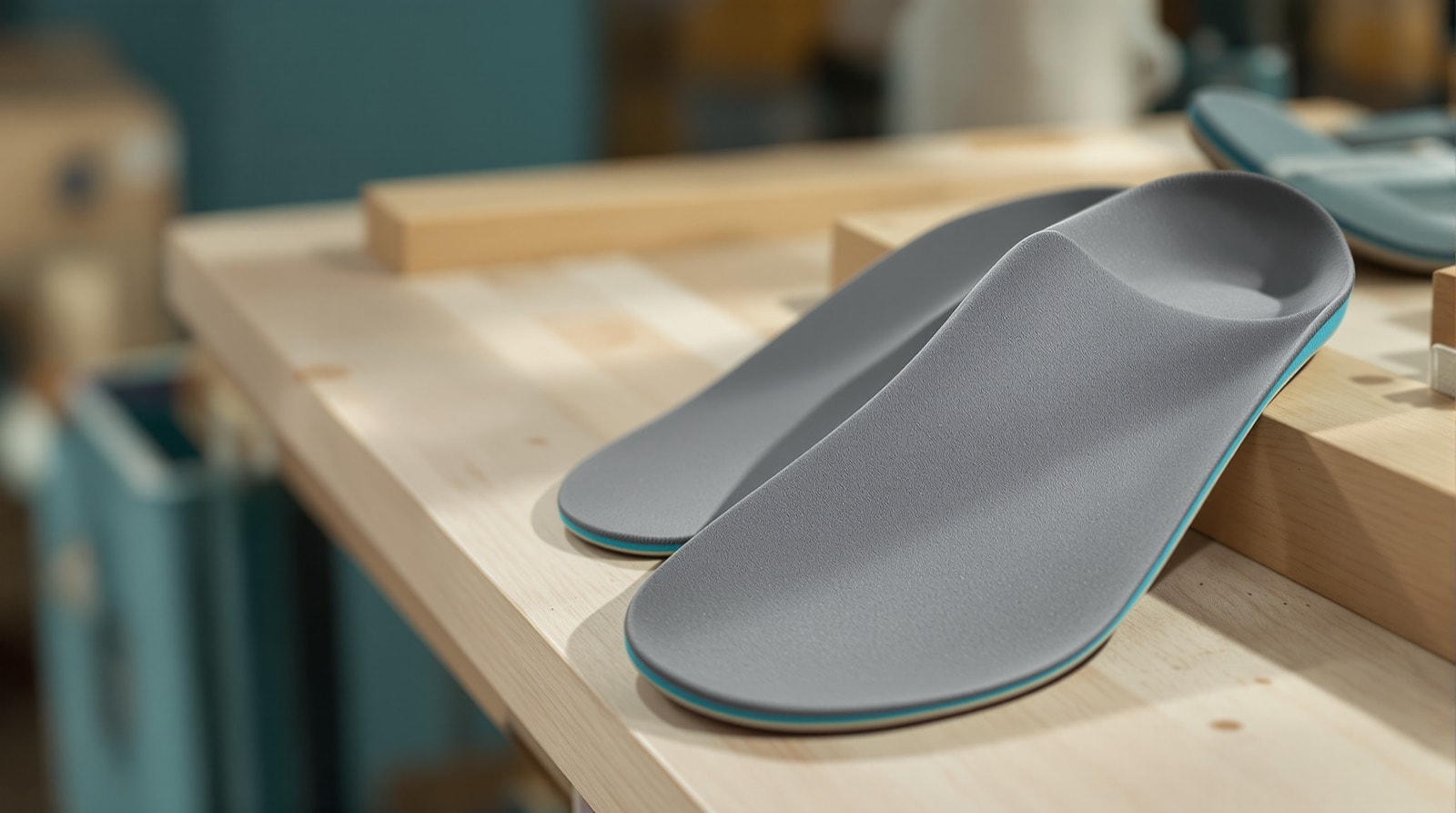
Two broad categories
Functional orthoses are designed to influence motion. They are made from semi-rigid materials — polypropylene, carbon composite, firm EVA — and are used where the working hypothesis is that abnormal movement of the foot is producing symptoms, whether in the foot itself or further up the chain at the shin, knee or hip. They are the type generally prescribed for conditions such as plantar heel pain, posterior tibial tendon problems, shin pain and some patellofemoral pain.
Accommodative orthoses are designed to redistribute pressure and cushion. They are softer — multi-density foams, plastazote, poron — and are used where the aim is to protect tissue rather than to change movement: painful calluses, forefoot pain from thinning fat pads, rheumatoid feet, and above all the insensate or previously ulcerated diabetic foot, where offloading a high-pressure area is the entire point.
In practice many devices are hybrids, with a functional shell and accommodative topcovers or cut-outs. The categories are a way of describing intent, not a hard taxonomy.
Custom versus off-the-shelf
This is the question most people arrive with, and the honest answer is more nuanced than either side of the argument usually admits.
Custom devices are made to an impression, scan or cast of the individual foot, with a prescription specifying materials, posting, arch profile and any additions. They can accommodate an unusual foot shape, a rigid deformity, a leg length difference or a specific offloading requirement that a stock device cannot. Where a foot is genuinely atypical, or where the requirement is to unload one precise area, custom is not a luxury.
Off-the-shelf devices are prefabricated in a range of sizes and arch profiles. They cost a fraction of custom devices, are available immediately, and — this is the part that surprises people — perform comparably to custom devices in trials for several of the commonest indications, including plantar heel pain. For a typical foot with a typical mechanical problem, a reasonable prefabricated device is a sensible first attempt.
The sensible sequence for most people is therefore: try a well-chosen prefabricated device first, and move to custom if it fails, if the foot is unusual, or if the clinical requirement is specific. Starting with the most expensive option is not the same as starting with the best one.
What orthoses can reasonably be expected to do
Reduce symptoms in a proportion of people with mechanically driven foot pain, particularly plantar heel pain, when used alongside — not instead of — stretching, strengthening, load management and appropriate footwear. Redistribute pressure away from an at-risk area of the sole, which in the diabetic foot is a genuine and well-supported use. Accommodate a fixed deformity so that shoes become wearable.
What they cannot reliably be expected to do: permanently change the structure of an adult foot, correct a bunion, cure a condition on their own, or prevent injury in a general population. Claims of that kind circulate widely and are not well supported.
Fitting, breaking in and shoes
An orthosis is only as good as the shoe it lives in. A device with any meaningful arch profile needs a shoe with a removable insole, a deep enough heel counter and adequate volume — putting one into a flat court shoe or a slim trainer usually fails on space alone. It is normal for a new functional device to feel odd for one to two weeks; most people are advised to build up wearing time gradually rather than going straight to a full day.
Some discomfort during the settling period is expected. Pain is not. New pain, numbness, a hot spot, or a blister — particularly in anyone with reduced sensation — means the device should be reviewed rather than persevered with.
Assessment first, device second
An orthosis prescribed without an examination is a guess. A reasonable assessment looks at the foot standing and non-weight-bearing, checks joint range and muscle strength, palpates for the actual source of pain, observes walking, and considers what the person needs to do in the device. Devices dispensed on the basis of a pressure-plate readout alone, or from a machine in a shop, are unlikely to be founded on any diagnosis at all.
It is also worth being clear about what the orthosis is for. A device aimed at plantar heel pain and a device aimed at offloading a pre-ulcerative callus are trying to do different things, and one will not do the other's job. The background on the conditions themselves is on the heel pain, flatfoot and diabetic foot pages; the orthopaedic patient summaries at OrthoInfo cover where orthoses sit in the overall management of heel pain.
Care and lifespan
Functional shells commonly last several years; topcovers wear out sooner and are usually replaceable. Accommodative devices compress and need replacing considerably more often — in a high-risk diabetic foot, on a schedule rather than when they look worn, because a flattened offloading device has stopped offloading. Clean with a damp cloth, air-dry away from direct heat, and never dry them on a radiator, which will distort the shell.
Finally: if a device stops helping, that is information. It may have worn out, the shoes may have changed, or the diagnosis may not have been right in the first place. It is worth going back rather than quietly abandoning the device in a drawer.